

In geotechnical engineering, the accurate simulations of fractured and joint rock masses are so important. It is critical for the safe design of the tunnels, slopes, caverns, and underground excavations. Previously, traditional continuum models often failed to capture the mechanical behaviour controlled by the discontinuities.
Rocscience’s numerical tools offer advanced capabilities to address this challenge.
Through the jointed rock modelling and Discrete Fracture Network (DFN) simulations, RS2 and
RS3 allows engineers to create realistic representations of the rock masses. It makes them indispensable for modern geomechanics.
Today, professionals are actively seeking structured Rocscience learning. It includes guided rock science training modules and hands-on modelling sessions. And the purpose behind this is to confidently use these advanced tools in real-world projects.
What Is The Jointed Rock in Rocscience
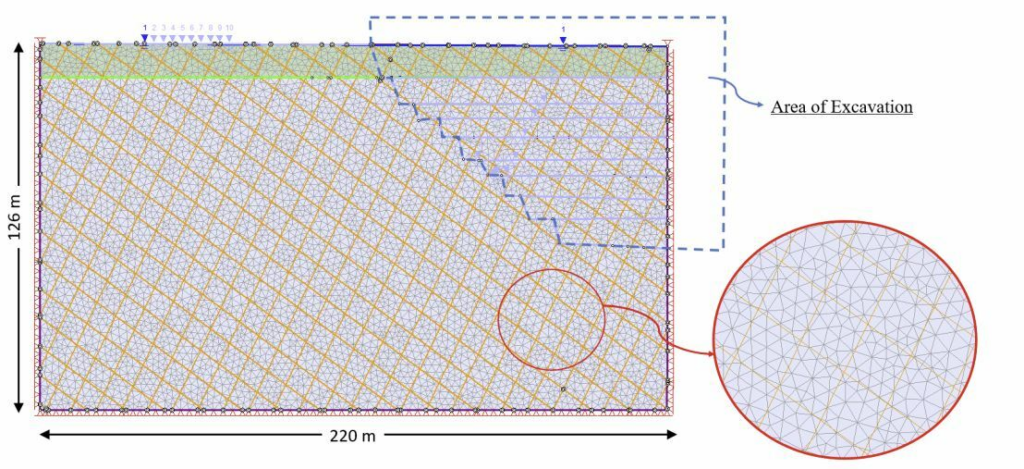
The jointed Roock model in Rocscience represents the rock masses where deformation and failures are directed by the discontinuities. Instead of treating rock as a uniform continuum, RS2 and RS3 incorporate:
- Joint Orientations
- Spacing and Persistence
- Shear Strength parameters
- Roughness and dilation
- Anisotropic stiffness and strength
This model allows engineers to immerse mechanical behaviour directly into the material definition. For the scenarios that require precise geometry, explicit joint elements can also be inserted to simulate slip, separation, and shear softening.
This is an essential skill covered in the many practical RS2 and RS3 training sessions. It is especially for the engineers working in underground and high-stress environments.
What is Discrete Fracture Network (DFN) in Rocscience
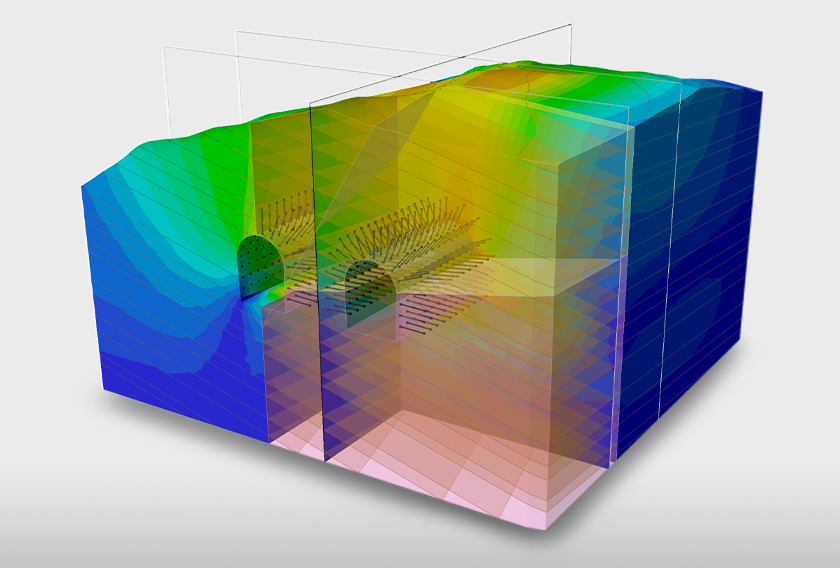
DFN represents the fractures that occur naturally by using statistical distributions derived from field measurements. It includes borehole logs and the scanline mapping. Rocscience enables DFN creation by defining:
- Orientation sets
- Length distributions
- Aperture ranges
- Spatial density
- Clustering or random scatter patterns
DFN can be used in both the models, i.e., 2D RS2 and the full 3D RS3. It is used to simulate block formation, groundwater flow, and the probabilistic failure mechanisms. Mastering the DFN workflows is a key to learning objectives in many rock science skill training tutorials.
What are the Applications of the Jointed Rocks and DFN
The applications of the jointed rocks and the DFN are as follows:
1. Underground Excavations and Tunneling
Jointed rock models predict the convergence, shear slip along joints, and the block detachments. DFN helps to identify unstable wedges and fracture-controlled deformation zones. It is to improve support design and the excavation sequencing.
2. Slope Stability
Combined joint sets and DFN simulate planar, toppling, and wedge failures with realistic failure surfaces. Engineers can run multiple DFN realizations to quantify variability and the failure probability.
3. Groundwater-Fracture Interaction
DFN apertures define flow paths. It allows the hydro-mechanical coupled analysis in RS2/RS3. It is essential for the water-bearing tunnels and the hydropower caverns.
4. Mining and Cavern Design
Joint activation, rockburst-prone zones, and yield development around excavations can be captured accurately when both the jointed rock and the DFN are used together.
Conclusion
Jointed rock and DFN modelling in Rocscience are transforming how engineers analyse and design in the fractured rock environment. These tools help to reduce the uncertainty, improve prediction accuracy, and enable safer, data-driven decisions.
Engineers who want to master these capabilities can accelerate their learning through PIGSO LEARNING. It is a platform that offers structured rock science training, practical RS2 and RS3 modelling sessions, and the step-by-step Rocscience RS2 and RS3 Training tutorials designed for real project applications.
It equips professionals with the hands-on expertise needed to confidently use the advanced Rocscience workflow in modern geotechnical engineering.
Contact us today to get started!
